
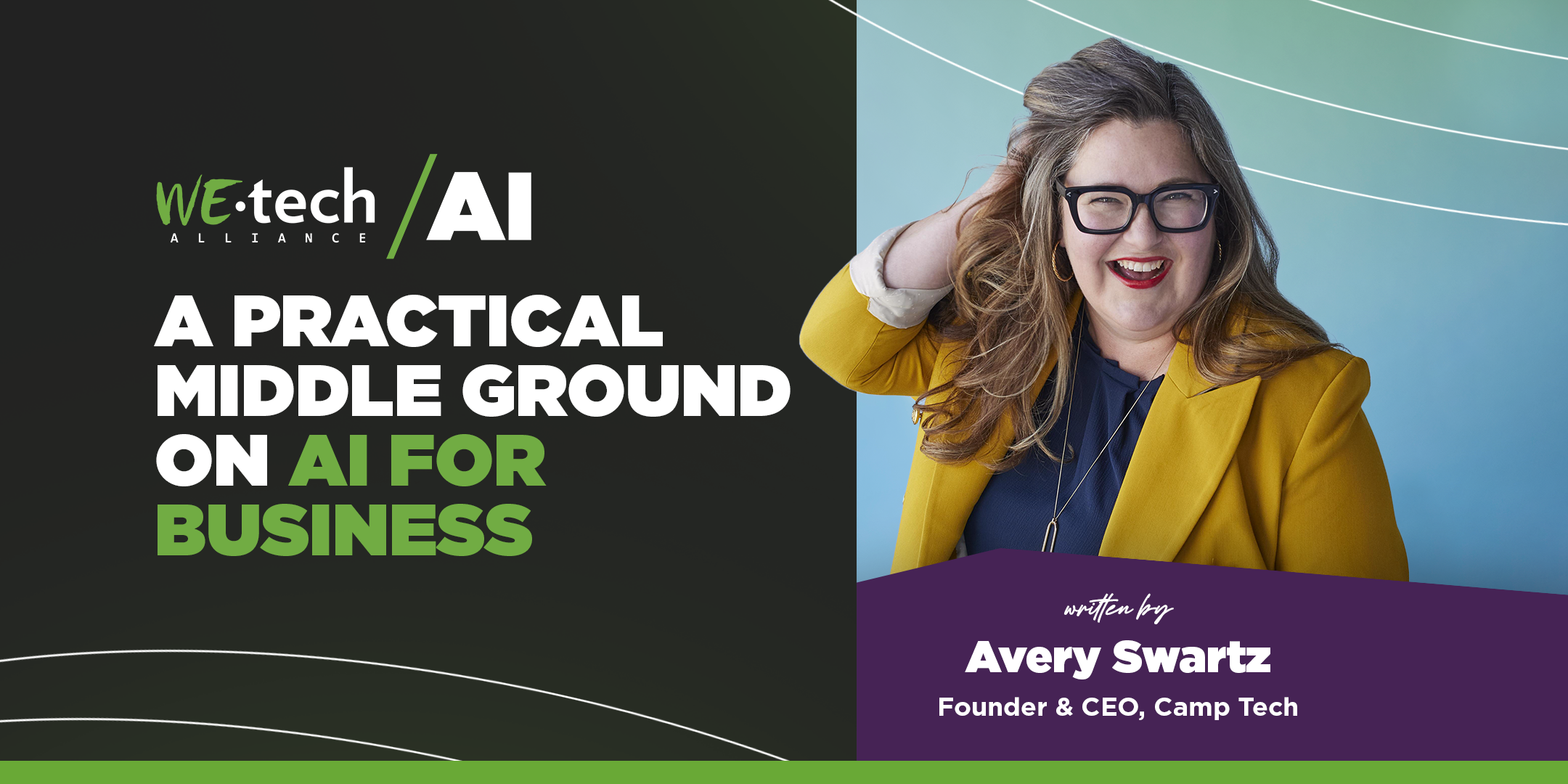
Guest blog post by Avery Swartz, Founder and CEO, Camp Tech.
It’s hard to have a realistic conversation about AI and business today. The public discussion has become polarized. There are AI doomers – those that are convinced AI poses an existential, extinction-level threat. Then there are AI boomers – the techno-optimists who believe AI will deliver a utopian future free of disease and economic strife. The arguments from both these camps can be so loud that they drown out any rational, pragmatic voices from the middle.
As someone who lives in the middle ground between AI doomers and AI boomers, I can tell you it’s complicated. We don’t need to look to hypothetical risks from AI development – we have more than enough real-world risks to be concerned already. The environmental cost of hyperscale data centres. The impact on the labour market. Chatbots confidently stating errors as if they’re facts. The effect of AI on cognitive skills. Algorithmic bias. I can go on.
And yet.
The businesses that Camp Tech has worked with are seeing real-world benefits from using AI. We see employees handing off repetitive and mundane tasks, freeing them up for higher-value work they enjoy. I’ve seen small business owners use AI to do things they previously couldn’t, such as building and launching simple apps without touching a line of code. I’ve watched a conversation with a chatbot kickstart an entirely new business idea for an entrepreneur. Another entrepreneur told me that using AI reduces the mental load she experiences in running her business.
The catch is that real-world benefits arrive alongside real-world risks, and Canada has no federal law governing how businesses use AI. While privacy law applies and matters a great deal, the question of how to use AI responsibly and in line with a company’s own values is largely up to each organization. Entrepreneurs and small business owners are left to set their own rules.
Bringing AI into a business right now can feel like handing employees the keys to a fast car and sending them onto a highway with no lanes, no speed limits, no stop signs and no traffic lights. Some people will drive carefully and some will not, and nobody can say with confidence where the edges of the road are. So how do businesses get the boost that AI can give while minimizing the risks?
Businesses do not have to wait for someone else to paint the lanes. The companies I have seen get the most out of AI, while avoiding many of its risks, have made deliberate decisions about how their people use it. They have AI use policies, and they also provide the clear day-to-day guidance their teams require. Everyone in an organization needs to know which tasks AI can be used for and which it can’t, what information never goes into an AI tool, how to appropriately check AI-generated work, and who is accountable when something goes wrong. That guidance is especially needed when a company is growing, because every new hire arrives with their own habits and assumptions about AI.
Working from the middle ground means treating AI as a set of practical business decisions that can be made now with the information available, shared with the whole team, and revisited as the technology and the rules change. The doomers and the boomers can keep arguing about where AI is headed. In the meantime, those of us in the middle will be over here thoughtfully putting AI to work.
If you’re interested in learning more about values-aligned approaches to AI adoption, I hope to see you at WEtech this fall. Join me online on October 21 for Scaling with AI: The Practical Decisions to Make Before You Grow. We’ll look deeper into the choices leaders can make now so that AI use stays intentional as their teams expand. On November 20, I will be in Windsor for WEtech’s AI x Women event, where we will work through a framework for deciding where AI fits in a business and where the line between acceptable and unacceptable AI use should sit. Both sessions draw directly from my work training small businesses and nonprofits across Canada and internationally.

Avery Swartz is the founder and CEO of Camp Tech, a Canadian tech and AI skills training company. She is the bestselling author of See You on the Internet: Building Your Small Business with Digital Marketing and is the resident tech contributor on CTV’s Your Morning.